Friday, February 11, 2011

APOD 3.4

Star Colors in Orion (11 Feb. 2011)

This picture shows the stars in the constellation Orion. This photograph shows the stars kind of smeared out because the photographer used a photographing technique called a step-focus technique. This technique requires the photographer to take a series of 35 consecutive exposures. When combined, these exposures make trails of stars moving from left to right through the frame that changes focus in steps. Starting and ending with the camera out of focus makes a sharply focused exposure near the middle of the series which is why it resembles the shape of a bowtie. In the upper left, is the red supergiant Betelgeuse. Below center is the pinkish Orion Nebula, and near the center right edge is W Orionis.

This picture was interesting because it's related to what we just learned in class, how stars are different colors and why. The red stars, like Betelgeuse, appear red because they are cool. They have surface temperatures around 3,000 K. Blue stars are hotter and have temperatures over 30,000 K. But it's size and distance away affects how bright it actually appears to us. It was also interesting to learn about this photographing technique and how they photograph stars to see their true colors. In this photograph, you can easily distinguish the different colors of the stars and how bright they appear. Although, there may also be other factors that contribute to the color like W Orionis. It's red color is enhanced by it's carbon-rich composition.

Tuesday, February 8, 2011

Observation (2/8/11)

Location: My driveway in Osprey
Time: 8:30 P.M.
Weather Conditions: Clear skies

Tonight I was able to have a good clear view of the sky. The moon was visible in the west. It was a bright waxing crescent. In the north, I was able to see the Ursa Minor and Polaris. It was faint so I had to block the lights from my house with my hands to be able to see it. Orion was visible up above and I was able to see Orion's belt and the stars that make up his dagger. Sirius could also be seen to the lower left. There were also a few more bright stars even more left of it that I believe could have been Castor and Pollux.

Friday, February 4, 2011

APOD 3.3

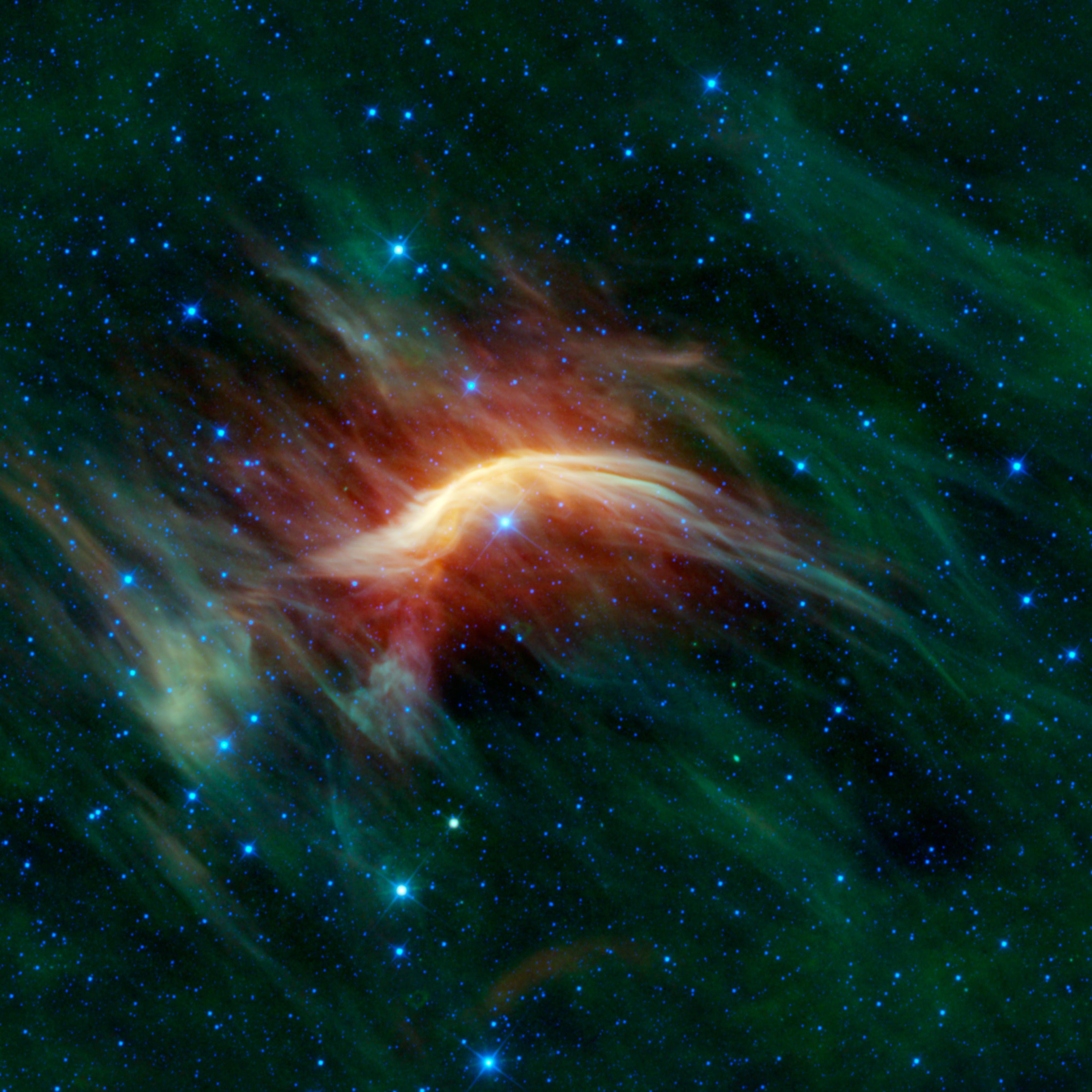
Zeta Oph: Runaway Star (4 Feb. 2011)

This picture is of a runaway star named Zeta Oph, which can be located in the constellation Ophiuchus. A runaway star is a massive star that travels rapidly through interstellar space. Because it is rapidly traveling throught interstellar space at 24 km/sec, Zeta Oph created the arcing interstellar bow wave or bow shock seen in the picture. That is the orange/reddish arc that can be seen in the center of the picture. Zeta Oph is the blue shining point that is located in the arc. As seen from this picture, it should be moving towards the top of this frame. This star is moving through interstellar material. Interstellar material is the material which fills the space between the stars. These areas have very little matter in them and mainly consists of gas and dust, which is what we've learned about in class. There may be a small amount of dust particles per cubic cm, but with the great distances between the stars, the number of dust particles really add up.
With Zeta Oph, it has strong stellar winds that precede it. These winds compress and heat the dusty interstellar material and shapes the curved shock front. 
The thing that actually started to make this a runaway star was the explosion of its companion when it was in a binary star system. Because it's  companion star was much larger, it had a shorter life span. A star's life cycle is determined by its mass. The bigger it is the shorter its life cycle. When it's companion exploded as a supernova, this explosion propelled Zeta Oph through the system. It was actually flung 460 light-years away and it is actually 65,000 times more luminous than the sun. However as we learned that the numbers of dust particles add up through space and dust is like fog, this explains why this dust surrounded star isn't one of the brightest in the sky.

Friday, January 28, 2011

APOD 3.2

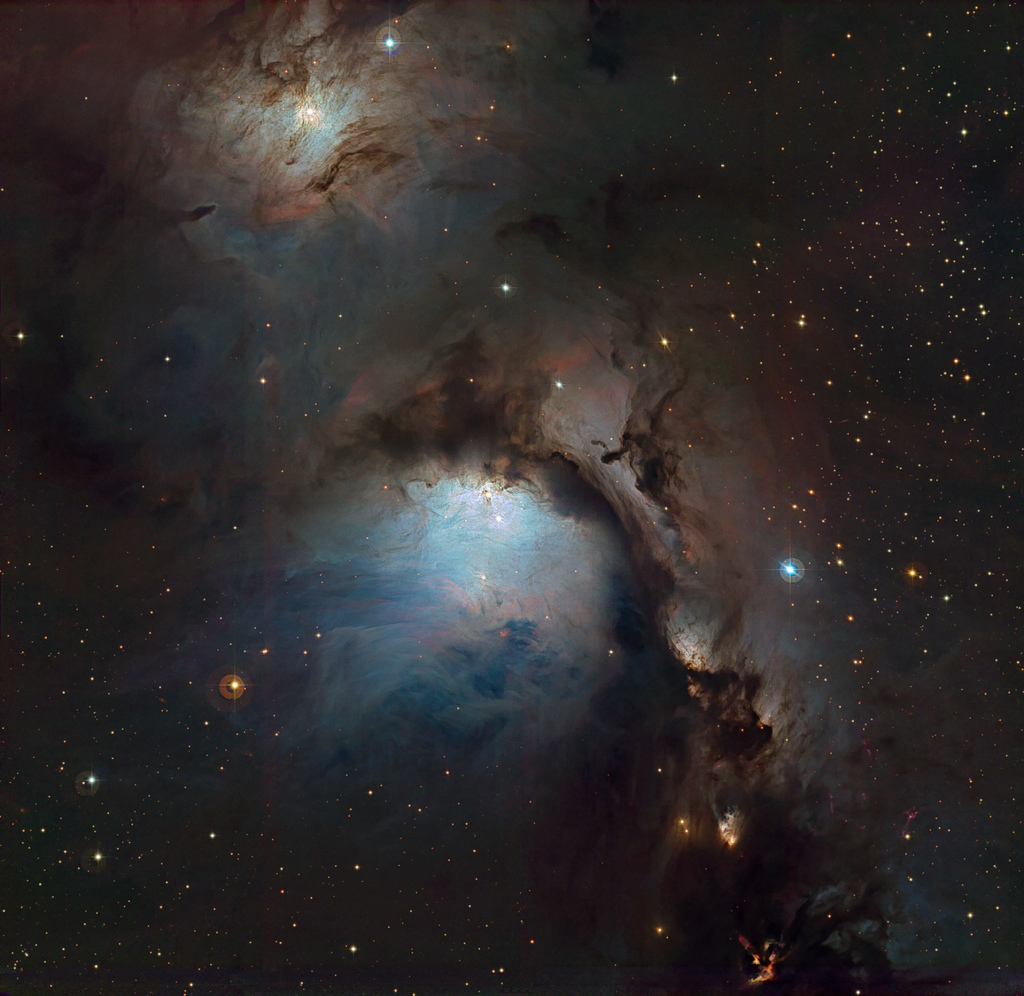
Hidden Treasures of M78 (27 January 2011)

This apod shows a picture of M78. It is about 1,600 light-years away and is located in the the constellation Orion. This is a large, bright, and well known reflection nebula. The blue seen in this nebula is caused by the reflection of wavelengths which is why it is a reflection nebula. When interstellar dust grains are near a bright star, clouds of these dust particles scatter short wavelengths of visible starlight more readily than long wavelengths. This produces the blue color that is seen in the nebula. There are many more examples of reflecting nebulae like the Iris Nebula (NGC 7023) and the Witch Head (IC2118). 
This picture was taken by Igor Chekalin who won the Hidden Treasures 2010 astrophotography competition held by the European Southern Observatory. Seeing this photograph and the other photos that were entered, it's amazing what these amateur astronomers could do.
Also in this picture, in the bottom right, is McNeil's Nebula. It has a yellowish color and was apparently discovered by an amateur astronomer, Jay McNeil who was testing out his new telescope by focusing on the area around M78. The story behind the discovery of McNeil's Nebula was interesting to read because I would assume that other professional astronomers with access to observatories and high tech equipment would have already discovered it long ago.

Friday, January 21, 2011

APOD 3.1

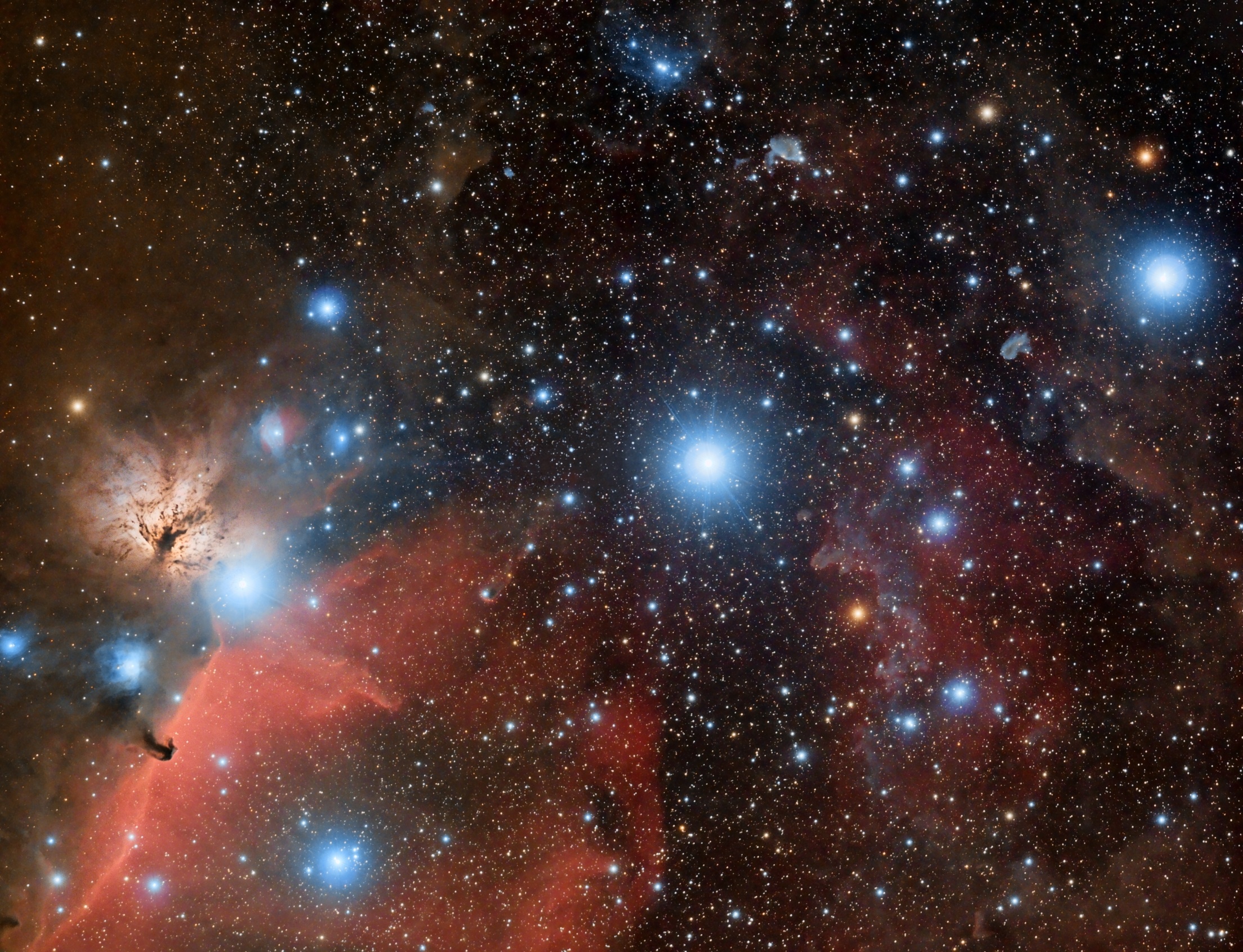
Alnitak, Alnilam, Mintaka (January 21, 2011)

This picture shows the stars that makes up Orion's belt. In the lower left is Alnitak, in the middle is Alnilam, and in the upper right is Mintaka. They are all second magnitude and blue supergiant stars that are hotter and more massive than the Sun, but much younger than our sun. Together they are known as Orion's belt. Alnitak means the girdle. Alnilam means "a belt of pearls". And Mintaka comes from the Arabic word for belt. They are about 1,500 light-years away and came from Orion's interstellar clouds. In the lower left of the image the Horsehead Nebula and Flame Nebula can be seen. It seems that eventually the fate of Alnitak and Alnilam is to become a red supergiant like Betelgeuse and explode as supernovae. Mintaka will also be famed in death due to the other star's explosions.
I picked this apod because we have just discussed these three stars yesterday in starlab. We did not go into much details, besides their names, and this was a good way to learn more about these stars that I have often seen. It was interesting to know just how massive and bright they were. Alnitak alone is 10,000 times more luminous than the sun and a planet like Earth would have to be 300 times farther from Alnitak than Earth is from the Sun for life like ours to survive.

Friday, January 14, 2011

Observations (1/13/2011)

Yesterday morning on January 13 at around 6:10 am, I was able to see Venus from my driveway in Osprey. It was visible in the southeast and it was very bright. It was the brightest thing in the morning sky because there was no moon. The skies were very clear and other constellations and stars were visible. I was able to see ursa major in the north. I was not able to completely see scorpius, but I was able to see the star Antares a little below Venus. It was a small red glimmering light.

APOD 2.10

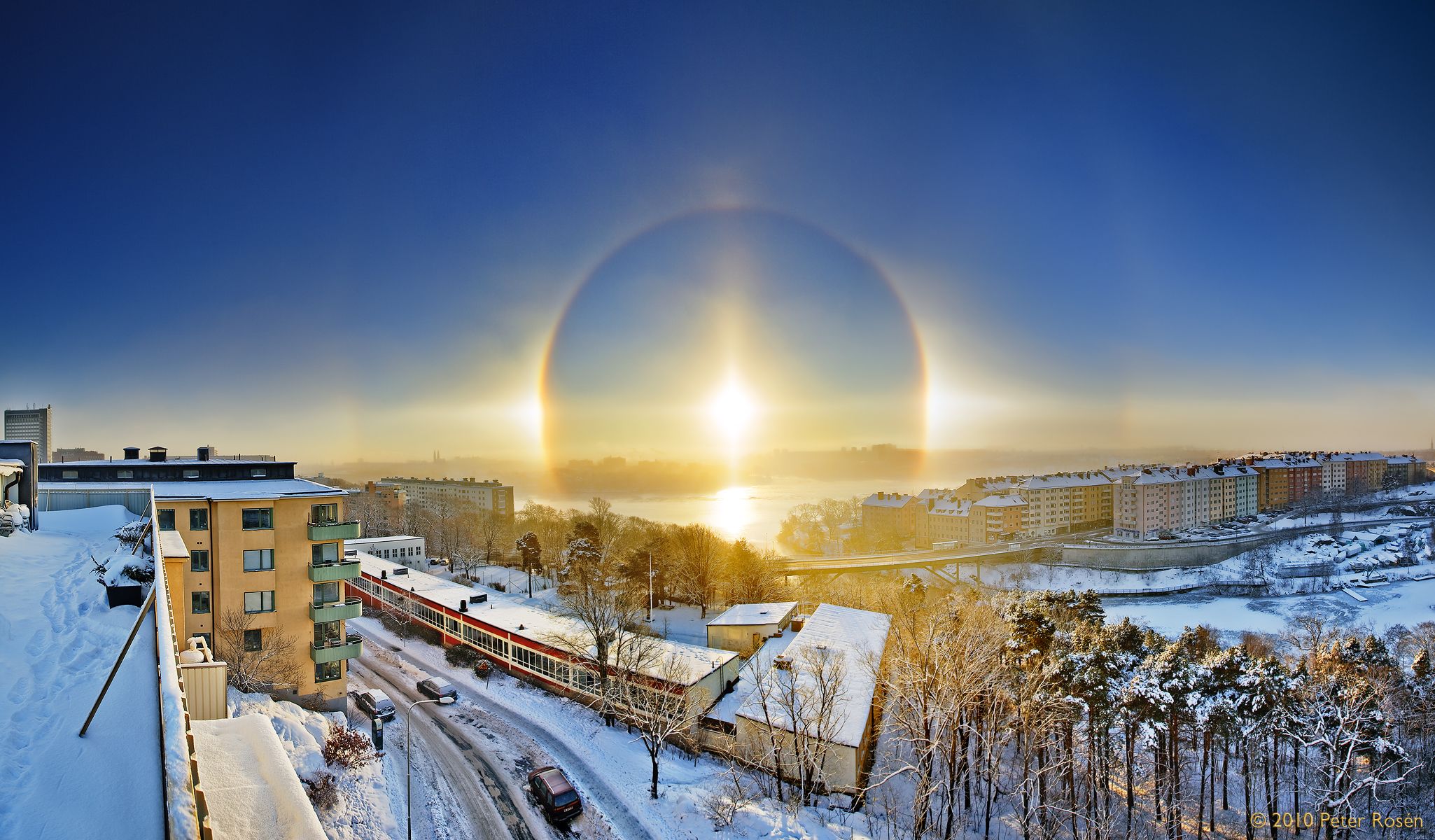
"A Sun Halo Beyond Stockholm" (January 10, 2011)

This picture was taken last year overlooking Stockholm, Sweden. It shows the sun surrounded by a halo and two sundogs each one to the right or left of the sun. The halo and sundogs surrounding the sun are caused by the ice crystals created in the atmosphere. When ice crystals form in the atmosphere in hexagonal prisms, they can create these atmospheric events. Halos come from the way small ice crystals in the atmosphere scatter sunlight into different angles. The quality of a halo depends on the type and quality of the ice crystals that produce it. When these crystals flutter to the ground, they are mostly parallel to the ground with their faces flat. When this happens, each crystal can act like a lens, refracting the sunlight to form sundogs, also know as parhelia. The first halo seen around the sun is the 22 degree halo. The fainter second halo seen in the picture is the 46 degree halo which is rarer. These halos can also occur around the moon.

This was an interesting APOD because most of the time for me, I focus more on the events and objects that occur at night like the stars and moon. I have never really focused on the sun before, which is what we are currently learning about. Even though we have mentioned sundogs before in class, I was never sure what they looked like so it was pretty exciting to see this picture. It was also great to know that these events could occur with the moon. I have previously seen a moon halo before but I wasn't quite sure about the cause.