- photosphere, sunspots, and granulation http://www.windows2universe.org/sun/atmosphere/photosphere.html
- coronal mass ejection http://www.windows2universe.org/sun/solar_activity.html
- A full-disk multiwavelength extreme ultraviolet image of the sun taken by SDO on March 30, 2010. False colors trace different gas temperatures. Reds are relatively cool (about 60,000 Kelvin, or 107,540 F); blues and greens are hotter (greater than 1 million Kelvin, or 1,799,540 F) http://www.nasa.gov/images/content/446589main_fulldiskmulticolor-orig_full.jpg
- A movie of the March 30, 2010, solar prominence eruption, as seen by SDO (the video is below the first image) http://www.nasa.gov/mission_pages/sdo/news/first-light.html
- Spicules on the sun http://www.nasa.gov/mission_pages/sdo/multimedia/gallery/spicules-20110106.html
- Video "Limb Active Region on the Sun" (2nd video in the side bar) http://www.nasa.gov/multimedia/videogallery/index.html?collection_id=15505&media_id=36274561
Wednesday, January 12, 2011
Sun


Tuesday, January 11, 2011
Quarter 2 Astronomer: Heinrich Olbers
Heinrich Wilhelm Matthias Olbers was a German astronomer. He was born on October 11, 1758 in Arbergen, near Bremen, Germany. He was the eighth child out of the sixteen children of Johann Jürgen Olbers. His father was a Protestant minister. He became interested in astronomy when he was around fourteen, but the institution he attended in Bremen at the time barely taught any mathematics or science. So, to better understand astronomy, he taught himself mathematics and tried to compute the solar eclipse of 1774.
In 1777, he started to study medicine in Göttingen under the guidance of Blumenbach and Ernst Baldinger. He also started to attend lectures in physics and mathematics by G. C. Lichtenberg and A. G. Kästner. Kästner was in charge of the small observatory at Göttingen. Even though he learned from all these people, he still mainly studied astronomy on his own. His biggest interests were with comets. His interest started in January 1779. He used his observations of Bode’s comet to calculate its orbit. In 1780, he independently discovered a comet that was also being observed by Montaigne at the same time.
Even with his great fascination for astronomy, he was still mainly a physician. In 1781, after he received his medical degree, he went on a study trip to Vienna. He visited hospitals during the day, and spent his nights in the Vienna observatory. At the end of that year, he settled down in Bremen and started an extensive medical practice. Mainly through his efforts, inoculation was introduced in Bremen and he was praised for his work during several cholera epidemics.
In 1785, he married Dorothea Köhne. She would die a year later after their daughter was born. In 1789, he was remarried to Anna Adelheid Lurssen. They would have a son. After his daughter’s death in 1818 and Lurssen’s death in 1820, he finally retired from active medical practice to devote the rest of his life to astronomy. He had an observatory put in on the second floor of his house using its two large windows for his telescopes. His library became one of the best private astronomical collections in Europe. For over fifty years he carefully collected astronomical literature and cometography that was almost complete.
At first he was too busy with medicine to do astronomy when he first moved to Bremen. But in 1786, he met J. H. Schröter. Schröter had a private observatory in nearby Lilienthal which was one of the best equipped on the continent and they worked closely together for many years. In 1796, Olbers discovered a comet and calculated its parabolic orbit with a new method that was easier than the one used by Laplace. He wrote a letter to F. X. von Zach, the director of the newly found observatory on the Seeberg, near Gotha. He asked him whether his argument on this new method should be printed and asked advice for how it should be done. After von Zach read the argument and used it to receive excellent results to find the orbit of the comet of 1779, which gave many astronomers difficulty, von Zach took it upon himself to see that Olber’s argument was printed. It appeared at Weimar in 1797 titled, Über die leichteste und bequemste Methode, die Balm eines Kometen am einigen Beo-bachtungen zu berechnen. His new method would make instantly establish him among the leading astronomers of his time. His new method was used throughout the nineteenth century.
When the first asteroid was discovered by G. Piazzi on Jan. 1, 1801, he noticed a star like object that moved during the following days. He sent out this information to other astronomers. Even though it was soon realized to be a new planet that Piazzi would name Ceres, it disappeared before more observations could be made. At that time it was still impossible to compute an orbit from such a small arc without assuming the eccentricity. However, Gauss was able to calculate it by a new method, and it was Olbers who found the new planet a year later where Gauss had calculated it to be. This was the start of their lifelong friendship.
After Ceres, Olbers discovered a second asteroid, Pallas, on March 28, 1802. With the discovery of a third asteroid, Juno, by Harding at Lilienthal in 1804, Olbers was able to use their orbits where they approached each other to discover Vesta on March 29, 1807.
One last thing that he was greatly known for is Olber’s paradox. According to the paradox, if we accept an infinite, uniform universe, the whole sky would be covered by stars shining as brightly as our sun. He explained the paradox of the dark night sky by assuming that space isn’t absolutely transparent and that some of the interspace matter absorbs a very small percentage of starlight. This effect is sufficient enough to dim the light of the stars so they look like points in the dark sky.
Olbers was respected and admired by many of his contemporaries. He worked with many of them including Gauss, Bessel, Encke, and Schröter. He also encouraged many young astronomers and helped them gain positions at various observatories. He died on March 2, 1840, but being the humble man that he was, he would claim that his greatest contribution to astronomy was leading Bessel to become a professional astronomer.
Works Cited
"Heinrich Wilhelm Matthias Olbers." 1911 Encyclopedia Britannica. 27 Oct. 2006. Web. 05 Jan. 2011. <http://www.1911encyclopedia.org/Heinrich_Wilhelm_Matthias_Olbers>.
"Olbers, Heinrich Wilhelm Matthias." Complete Dictionary of Scientific Biography. Vol. 10. Detroit: Charles Scribner's Sons, 2008. 197-199. Gale Virtual Reference Library. Web. 5 Jan. 2011.
Saturday, January 8, 2011
Observation (12/20-21/2010)
I observed the lunar eclipse from my driveway in Osprey between the night of the 20th and the morning of the 21st. The skies were clear and I was able to see the full moon. I would often go out every half hour starting at 1 am to see the shadow fall on the moon. As the shadow got bigger and bigger and covered more of the moon, it started to turn a orange/reddish color. Around 3 am, we were able to see the total lunar eclipse in the west.
APOD 2.9

This picture is of the sunset observed from the Teide Observatory at Tenerife, Cannary Islands, Spain. It shows a green flash, which is in fact not a myth. A green flash can be seen during a sunset. Just as the sun disappears completely, there is a flash of light that appears green. There are even blue ones. The cause of this is caused is from the layers of the Earth's atmosphere acting like a prism refracting and scattering the light. This is the same reason for why there are red sunsets. Green flashes are so rare because in uniform air, the dispersion is so small that the separation of red and green are not visible. It takes more unusual layering of the atmosphere to enhance the separation so the green can be visible. This is really interesting because I have heard about green flashes and I have never confirmed if it was real or not. It was really great to see the videos of the green flashes, which are so rare. I've only seen the green flashes in movies, but the videos I saw on the link are very similar and it makes me hope that I'll be able to see one in real life.
APOD 2.8
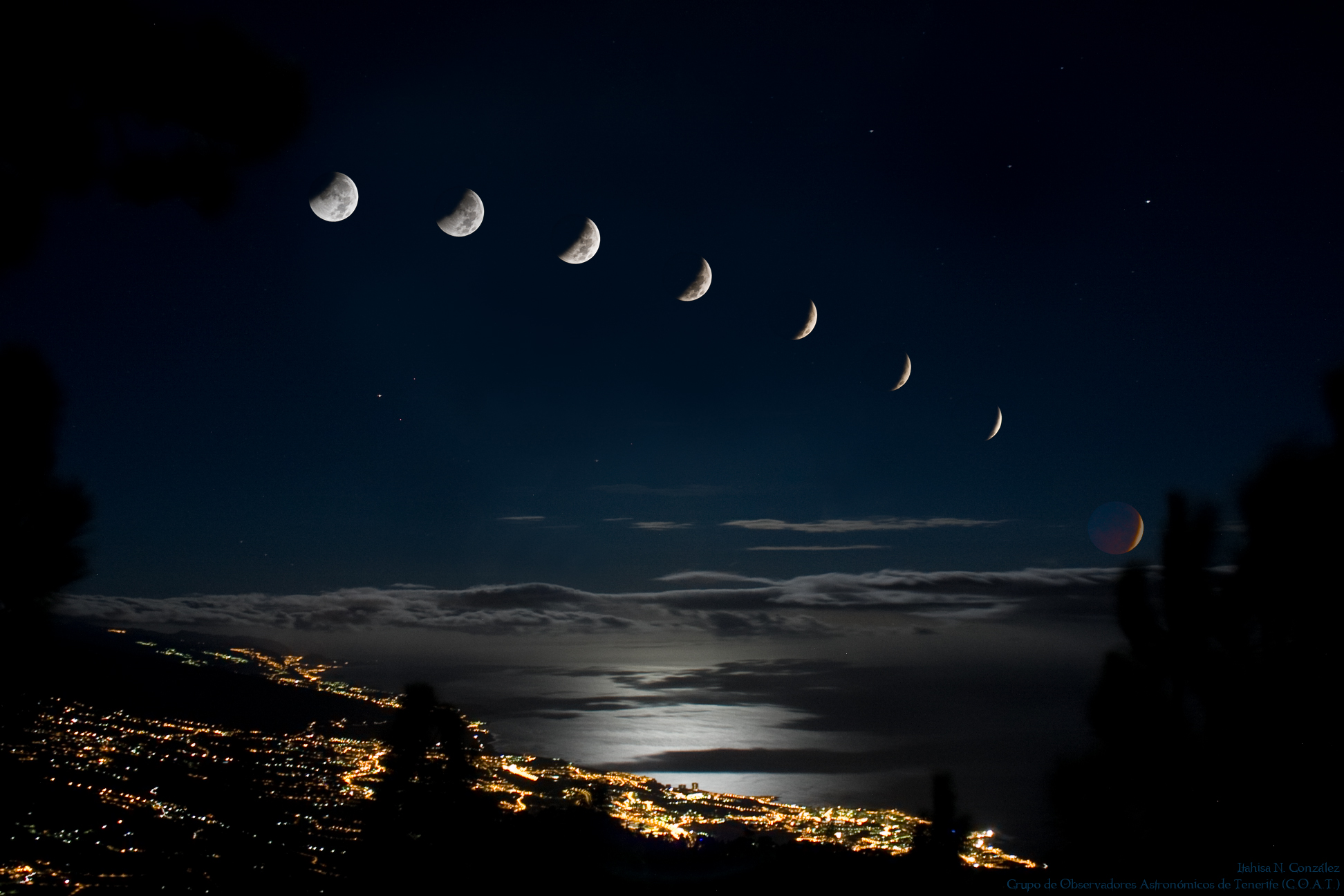
This picture shows the moon going through the phases of the lunar eclipse above Tenerife in the Canary Islands. The solstice lunar eclipse occurred during the morning of Dec. 21. Moving from left to right, you can see the moon growing smaller and smaller as it gets covered in the Earth's shadow. When the moon gets completely covered in Earth's shadow, or umbra, it has a orange/reddish color. This apod was interesting because it pertained to the moon, which was my subject for my astronomy presentation for quarter 2. So, it was easier to follow along with this apod because i already know the process involved with a lunar eclipse, which i actually did stay up to see. I was able to see the moon covered in the shadow and the total eclipse. The one thing that i didn't know before that i learned from this apod was why the moon turned into the orange/reddish color during the eclipse. Even though Earth blocks out most of the sunlight that reaches the moon, some of the light still reaches the moon. However the sunlight has to first past through earth's atmosphere which filters out the blue, so when it shines on the moon it looks orangey from the lack of blue.
Friday, January 7, 2011
APOD 2.7
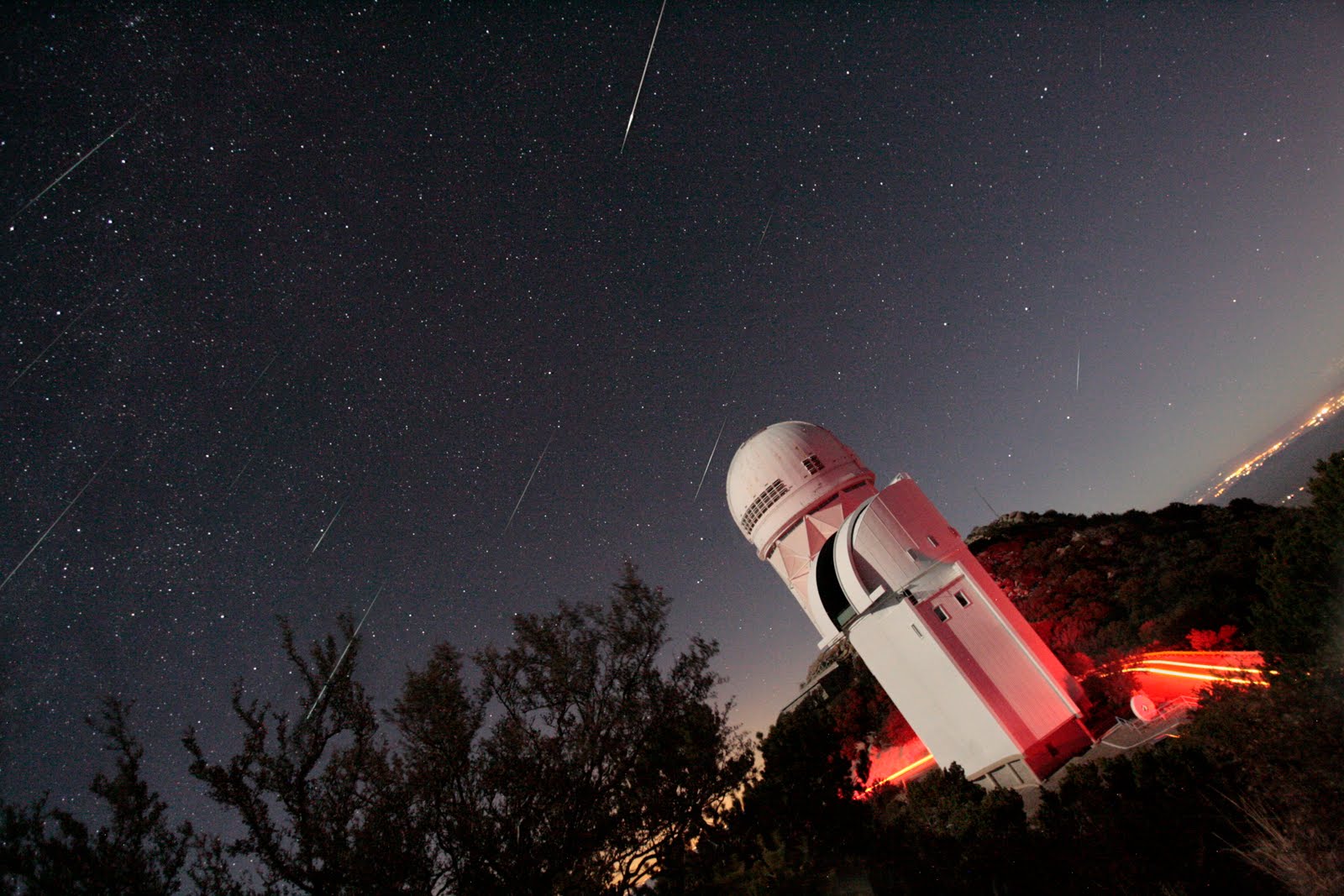
This picture shows the Geminid Meteor Shower from the Kitt Peak National Observatory which is located near Tucson, Arizona. This was taken early Tuesday morning. The closest building seen in this picture has the Bok Telescope and behind that is the Mayall 4 Meter telescope dome. However, the meteors were easily seen with the naked eye. The meteors come from Earth moving through dust from the asteroid-like object 3200 Phaethon.This meteor shower is unique because the meteors don't come from comets. It comes from a rock object called 3200 Phaethon that sheds very little dust debris which doesn't explain the Geminid showers. Of all the meteor showers that occur, this one is the most massive and it lasts for days. It can produce as many as 120 meteors per hour over dark-sky sites. The answer for the cause of the Geminid shower is still uncertain.
I chose this apod because the Geminid Meteor Shower was something I saw. I was not aware that this was an annual celestial event. I thought that a meteor shower was a one time thing. I saw it in the early morning around 5 am, and i was able to spot a few meteors. It was interesting to know that this was one of the most intense showers and that I was able to see it and the meteors i saw did in fact look like the ones in the picture.
Wednesday, January 5, 2011
Sources for Heinrich Olbers
- "Heinrich Wilhelm Matthias Olbers." 1911 Encyclopedia Britannica. 27 Oct. 2006. Web. 05 Jan. 2011. <http://www.1911encyclopedia.org/Heinrich_Wilhelm_Matthias_Olbers>.
- "Olbers, Heinrich Wilhelm Matthias." Complete Dictionary of Scientific Biography. Vol. 10. Detroit: Charles Scribner's Sons, 2008. 197-199. Gale Virtual Reference Library. Web. 5 Jan. 2011.
Subscribe to:
Posts (Atom)