Friday, February 18, 2011
Observation (2/17/11)
Yesterday night at 8 pm I went out to see the moon and the stars on my driveway. The moon was full up above in the east and it was very bright. It was cloudy but there were some empty spaces in the sky where you can see some stars and constellations. It was fairly bright so the stars were faint. I could see Orion and his belt in the south. Trying to draw out the "heavenly G" I could make out, from the east to south, Castor, Pollux, Procyon, Rigel, then up to Betelgeuse. Up above in the north, I could not make out any constellations, but there was a bright star where Auriga should be so I suspected that it was Capella.

Thursday, February 17, 2011
Sources for Simon Newcomb
- "Newcomb, Simon." Complete Dictionary of Scientific Biography. Vol. 10. Detroit: Charles Scribner's Sons, 2008. 33-36. Gale Virtual Reference Library. Web. 17 Feb. 2011.
- O'Connor, J. J., and E. F. Robertson. "Newcomb Biography." MacTutor History of Mathematics. Oct. 2003. Web. 13 Feb. 2011. <http://www-history.mcs.st-and.ac.uk/history/Biographies/Newcomb.html>.
Observation (2/17/11)
I went out this morning at 6:10 am on my driveway. The skies were clear. I could see Venus, which was very bright in the south-east. To the right of Venus, I could see Scorpius and Antares. The scorpion was oriented vertically up and down. Up above near the north, I could see the big dipper. As we learned in starlab, I followed the handle and I was able to locate Arcturus which was also bright.
Tuesday, February 15, 2011
Observation (2/15/11)
Tonight, I went out for observations around 9:10 pm. The skies were very clear, there were no clouds and I was on my driveway in Osprey. The moon was very bright. It was a waxing gibbous and it was almost full. It was right above a little to the east. When I was standing facing the moon, this time I was sure that the two stars to the left of the moon were Castor and Pollux because I checked the star charts. There were not as many stars visible however because the moon was so bright. Sirius could also be seen and I could make out the shape of the dog with his back, tail, and two legs. Nearby, as always, was Orion clearly visible with his belt and dagger and Betelgeuse with the reddish shine above in the south. Above in the southwest was a bright star, and from the previous constellations we learned this quarter, I believe that star was Aldebaran from the constellation Taurus although I was not able to see the shape of the bull.
Friday, February 11, 2011
APOD 3.4
Star Colors in Orion (11 Feb. 2011)

This picture was interesting because it's related to what we just learned in class, how stars are different colors and why. The red stars, like Betelgeuse, appear red because they are cool. They have surface temperatures around 3,000 K. Blue stars are hotter and have temperatures over 30,000 K. But it's size and distance away affects how bright it actually appears to us. It was also interesting to learn about this photographing technique and how they photograph stars to see their true colors. In this photograph, you can easily distinguish the different colors of the stars and how bright they appear. Although, there may also be other factors that contribute to the color like W Orionis. It's red color is enhanced by it's carbon-rich composition.
Tuesday, February 8, 2011
Observation (2/8/11)
Location: My driveway in Osprey
Time: 8:30 P.M.
Weather Conditions: Clear skies
Tonight I was able to have a good clear view of the sky. The moon was visible in the west. It was a bright waxing crescent. In the north, I was able to see the Ursa Minor and Polaris. It was faint so I had to block the lights from my house with my hands to be able to see it. Orion was visible up above and I was able to see Orion's belt and the stars that make up his dagger. Sirius could also be seen to the lower left. There were also a few more bright stars even more left of it that I believe could have been Castor and Pollux.
Time: 8:30 P.M.
Weather Conditions: Clear skies
Tonight I was able to have a good clear view of the sky. The moon was visible in the west. It was a bright waxing crescent. In the north, I was able to see the Ursa Minor and Polaris. It was faint so I had to block the lights from my house with my hands to be able to see it. Orion was visible up above and I was able to see Orion's belt and the stars that make up his dagger. Sirius could also be seen to the lower left. There were also a few more bright stars even more left of it that I believe could have been Castor and Pollux.
Friday, February 4, 2011
APOD 3.3
Zeta Oph: Runaway Star (4 Feb. 2011)
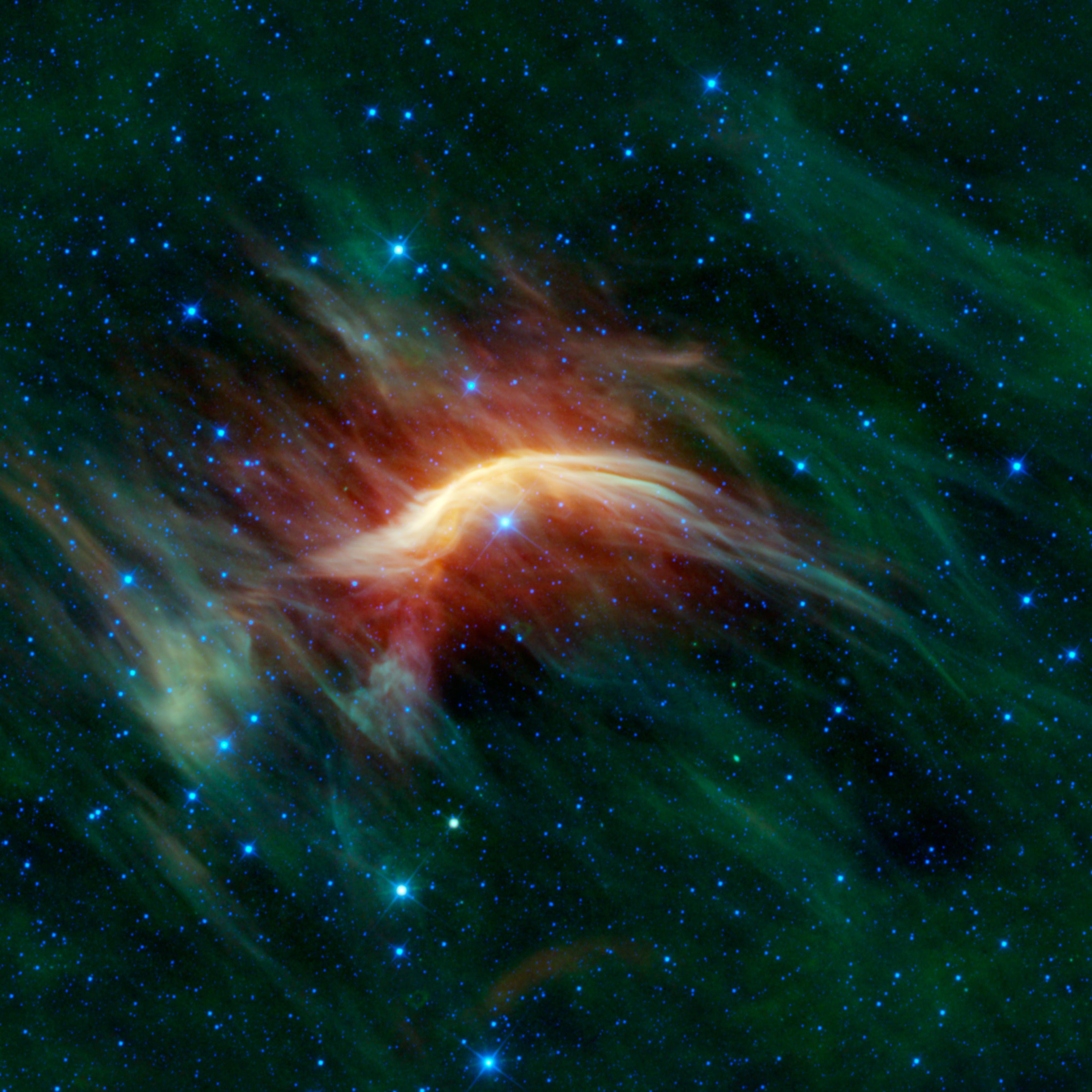
This picture is of a runaway star named Zeta Oph, which can be located in the constellation Ophiuchus. A runaway star is a massive star that travels rapidly through interstellar space. Because it is rapidly traveling throught interstellar space at 24 km/sec, Zeta Oph created the arcing interstellar bow wave or bow shock seen in the picture. That is the orange/reddish arc that can be seen in the center of the picture. Zeta Oph is the blue shining point that is located in the arc. As seen from this picture, it should be moving towards the top of this frame. This star is moving through interstellar material. Interstellar material is the material which fills the space between the stars. These areas have very little matter in them and mainly consists of gas and dust, which is what we've learned about in class. There may be a small amount of dust particles per cubic cm, but with the great distances between the stars, the number of dust particles really add up.
With Zeta Oph, it has strong stellar winds that precede it. These winds compress and heat the dusty interstellar material and shapes the curved shock front.
The thing that actually started to make this a runaway star was the explosion of its companion when it was in a binary star system. Because it's companion star was much larger, it had a shorter life span. A star's life cycle is determined by its mass. The bigger it is the shorter its life cycle. When it's companion exploded as a supernova, this explosion propelled Zeta Oph through the system. It was actually flung 460 light-years away and it is actually 65,000 times more luminous than the sun. However as we learned that the numbers of dust particles add up through space and dust is like fog, this explains why this dust surrounded star isn't one of the brightest in the sky.
Subscribe to:
Posts (Atom)