Friday, May 20, 2011

APOD 4.8

The Last Launch of Space Shuttle Endeavour (2011 May 18)


This picture was taken of the Endeavour after it took off. There were six astronauts aboard and was on its way to the International Space Station. Part of it's mission is to deliver to the ISS special equipment which includes a detector called the Alpha Magnetic Spectrometer 2. This is supposed to be able to detect a significant abundace of specific types of dark matter, charged, antimatter, and maybe strange variations of familiar matter called strangelets. This is the second to last launch. The last launch is currently scheduled for mid-July when Atlantis will also be launched to go to the space station. This was very interesting to see the picture and the follow-up video in the links. I was actually able to see the trail of smoke that the shuttle left behind during the launch after it disappeared in a cloud. This was the first time I actually observed something like this.

Thursday, May 19, 2011

Quarter 4 Astronomers: Gene and Carolyn Shoemaker

            Eugene Merle Shoemaker, also known as Gene, was born on April 28, 1928 in Los Angeles, California. He was very eager to learn and while their family lived in Buffalo, he went to the evening classes at the Buffalo Museum of Science for high school students even though he was still in elementary school. When he was seven, his mother gave him a set of natural-stone marbles. Along with the family’s summer trips in the West, this instigated his interest with rocks and stones and their inner structure. In 1944 when he was only sixteen, he attended the California Institute of Technology where he excelled and got his bachelor’s degree and master’s degree in geology in a short period of 3 years.
In the summer of 1948, she started working for the U.S. Geological Survey (USGS) where he learned how to differentiate between craters caused by underground forces and crater caused by an impact from above. In 1906, Daniel Moreau Barringer proposed that the Meteor Crater outside Flagstaff, Arizona was caused by a meteorite and not a volcano but had no way to prove it. So, Shoemaker examined the crater and confirmed Barringer’s belief. In 1960, with his colleagues, he isolated a mineral they found at Meteor Crater which he named “coesite.” This was the equivalent of a DNA fingerprint for extraterrestrial impact. Eventually he would find more coesite at other craters and basins. This new science was called astrogeology.
In 1973, he established the Palomar Planet-Crossing Asteroid Survey with Caltech geologist, Eleanor Helin. With the observations they gathered, he became one of the earliest people to come up with the theory that a catastrophic asteroid or comet impact could have been the cause of the annihilation of most of life on Earth 65 million years ago, which included the dinosaurs.
During the 1960’s, he was the leader of the teams investigating the structure and history of the moon and helped developed geologic mapping methods from telescope images. He was also the investigator in charge of the geological fieldwork that occurred during the first Apollo missions. He even helped in suggesting where those missions should land.
In 1950, Gene Shoemaker married Carolyn Spellman. Her brother was his roommate at Caltech. After her marriage, she decided to stay at home and raise their three children between 1952 and 1983, so she quit her job as a teacher. When Eleanor Helin left in 1982 to start her own asteroid search, Carolyn took her place after learning how to use the 18-inch Schmidt telescope. She would help her husband in his work. Helping each other, they discovered 32 comets and several hundred asteroids.
            In 1993 with David Levy, an amateur astronomer with a degree in English literature from Nova Scotia, they discovered a new object which is now known as the Periodic Comet Shomaker-Levy 9. With further study, it was suggested that this was just another comet that was caught in orbit around Jupiter due to the planet’s gravity. At one point in its path, the gravitational forces had pulled it into 21 fragments that looked like a string of pearls which were now falling into Jupiter.
            On July 18, 1997, when the Shoemakers were on a visit to Australia they were in a car crash. Carolyn survived but Gene, at age 69, died from his injuries. Carolyn is still alive and holds the record for most comets discovered.

Works Cited
  • Chapman, Mary G. "USGS Astrogeology: Carolyn Shoemaker." USGS Astrogeology Science Center. United States Geological Survey. Web. 10 May 2011. <http://astrogeology.usgs.gov/About/People/CarolynShoemaker/>.
  • "Gene Shoemaker." Encyclopedia of World Biography. 2nd ed. Vol. 20. Detroit: Gale, 2004. 335-338. Gale Virtual Reference Library. Web. 10 May 2011.

Sunday, May 15, 2011

Zooniverse

This week I did two hours of Zooniverse Planet Hunters in class. Currently, I have classified 343 stars.

APOD 4.7

Wonder and Mystery above the Very Large Telescopes (2011 May 9)


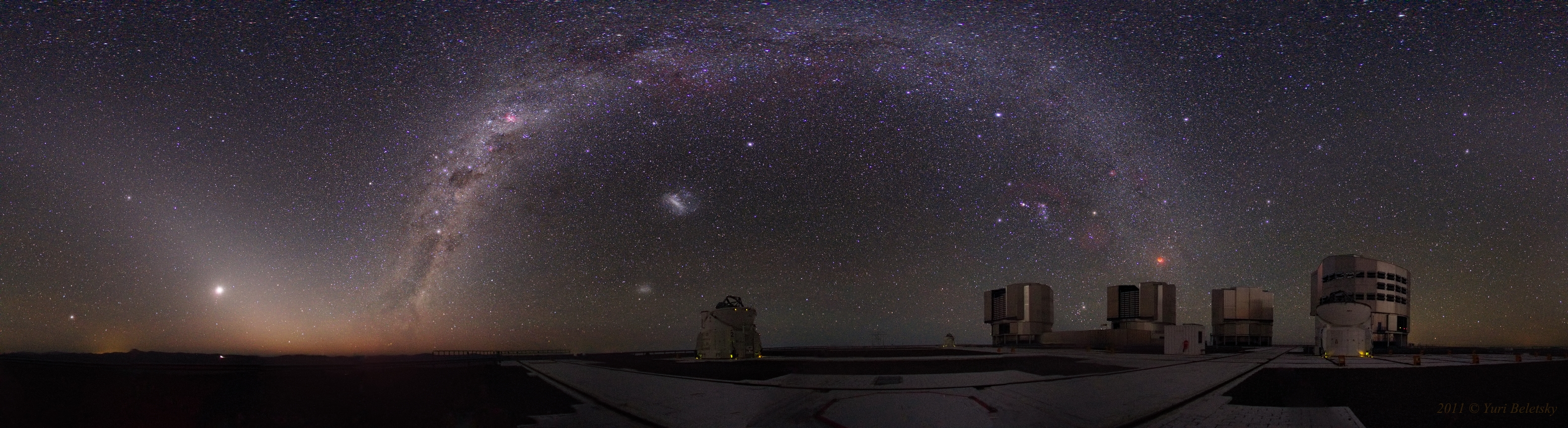
This is a picture of the sky above the Very Large Telescopes (VLT). This facility is for European ground-based astronomy. They have the world's most advanced optical instrument, with the the four Unit Telescopes to form the ESO Very Large Telescope Interferometer. This allows astronomers to see details up to 25 times finer than with the individual telescopes. This panoramic image in Chile, allows us to see many things. One of these diagonal bands of light to the far left is called zodiacal light. It comes from the sunlight reflected off of dust orbiting in the inner solar system. If you scroll your mouse over the image the different objects in the sky are identified and labeled. This was also taken during the total lunar eclipse last December so the moon actually appears orange. I am actually familiar with the constellations Canis Major and Orion, which appear in this photo. But with all the other stars in the sky it makes it harder to find them.

Saturday, May 7, 2011

APOD 4.6

Jupiter's Great Red Spot from Voyager 1 (2011 May 2)


This is a digital enhancement of Jupiter's Great Red Spot. This is a completed digital enhancement of a image of Jupiter taken in 1979 by the Voyager 1 spacecraft. The Great Red Spot is a anticyclonic storm and has l jat least 181 years and maybe even longer 346 years but it is unknown why it changes shape, size, and color. Also the Voyager 1 is currently the farthest human made object in the universe at about 117 AU from our planet. It is even expected to leave the heliosphere which is the region dominated by the solar wind and magnetic field. One of the interesting things about this APOD was being able to see the Great Red Spot with a little more depth into it because all the times I have seen the spot was when it's just a circle on the side of Jupiter and how scientists  efficiently use information they learned decades ago to help them in their research today.

Zooniverse

This week I continued planet hunters on zooniverse. I did one hour in class and my total number of stars classified is 280 stars.

Friday, April 29, 2011

Zooniverse

This week I did two hours of zooniverse in class. My total count of stars I have classified is 239.

APOD 4.5

The Antennae (2011 April 29)


This is a picture of two galaxies colliding in the constellation Corvus. The two galaxies are called NGC 4038 and NGC 4039. However, because galaxies are made up of mostly empty space filled with dust and molecular gases, their stars are not actually colliding. Only the gas and dust collide which helps to start star formation wear they collide. This collision is about 500 thousand light-years long. And the two streaks that look like antennaes are actually matter flung from the collision because of the gravitational tidal forces. The two areas of orange are actually the centers of the two colliding galaxy. I chose this apod because one of our constellations this week was corvus, the crow. With the links provided, I was able to learn of the myth of the crow and how the crow got it's black coat of feathers. It was interesting to read about the many different theories.

Tuesday, April 26, 2011

Zooniverse

Last week I did 2 hours of zooniverse on planet hunters in class. So far I have classified 174 stars and I even added one of the stars to my favorites because it had so many transits.

Monday, April 25, 2011

APOD 4.4

Peculiar Galaxies of Arp 273 (2011 April 21)


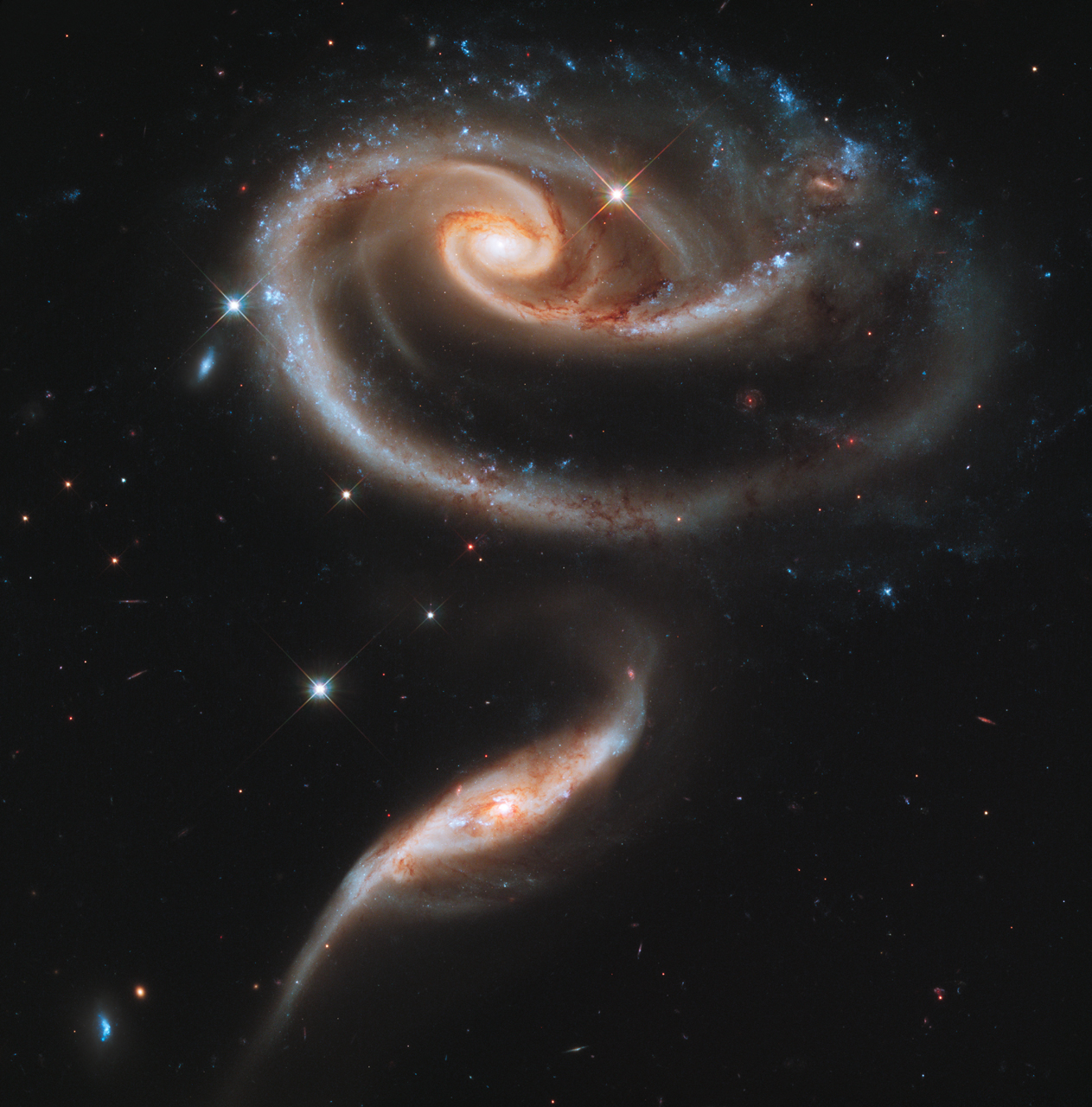
This picture is of the two galaxies of Arp 273. They are over 300 million light-years from the Milky Way Galaxy. There are about 5 bright spiky stars that are in the foreground of this picture. These stars are actually inside of the Milky Way Galaxy. So even with the distance between those stars and Arp 273, you can get a sense of how large these galaxies are. Their distorted appearance is due to gravitational tides as the two galaxies experience close encounters. This isn't strange at all though because interacting galaxies are actually very common. One example is with the Andromeda Galaxy and our own Milky Way. The Andromeda Galaxy is about 2 million light-years away and is getting closer to us. By observing Arp 273, astronomers may get a better sense of what could happen as the Andromeda Galaxy approaches us. In a video sequence from "Infinity Express: A 20-Minute Tour of the Universe," one can actually watch the results of these encounters that scientists have developed thanks to research and computer graphics. This was actually released in the Smithsonian Institution's National Air and Space Museum in Washington, D.C. in 2002 and was shown in the Einstein Planetarium. The result is supposed to be a merger into a single galaxy of stars. To be able to see this in the planetarium must have been amazing.

Saturday, April 16, 2011

Zooniverse

This is the second week doing zooniverse. I did another two hours in class which makes a total of four. So far I have classified 112 stars. 

APOD 4.3

50 Years Ago: Yuri's Planet (2011 April 12)ass

On April 12, 1961, Soviet cosmonaut Yuri Alexseyevich Gagarin became the first human in space. Gagarin was a military pilot and he was chosen for the first group of cosmonauts in 1960. In the Volstok 1 spacecraft, he was carried to an altitude of 200 miles and carried him once around the planet. His orbital flight lasted 108 minutes. About a month later, Alan Shepard would be the first US astronaut in space. His flight made him a hero throughout the world and a legend. In Gagarin's flight, he described that "The sky was very dark; the Earth is bluish. Everything is seen very clearly." This picture is what he would have most likely saw. This picture was taken from the ISS in 2003. He was killed in 1968 when his MIG jet crashed during a training flight. He had a hero's funeral and his ashes were interred in the Kremlin Wall. 20 years later on April 12, NASA launched the first space shuttle. This was interesting to read because it gave me a sense of how important his flight was. Everyone knew his name and admired him. And this picture does fit the description he gave. I also noticed that there can be a blue haze seen around Earth where the sky is. I actually never noticed that before.

Friday, April 8, 2011

Zooniverse

I chose to do planet hunters on zooniverse which involves looking at a graph of a star's luminosity and seeing where it plunges. If there is a sudden drop that means there was a transit and there is a possible planet. This week I did two hours of analyzing the graphs in class.

APOD 4.2

Verona Rupes: Tallest Known Cliff in the Solar System (4 April 2011)

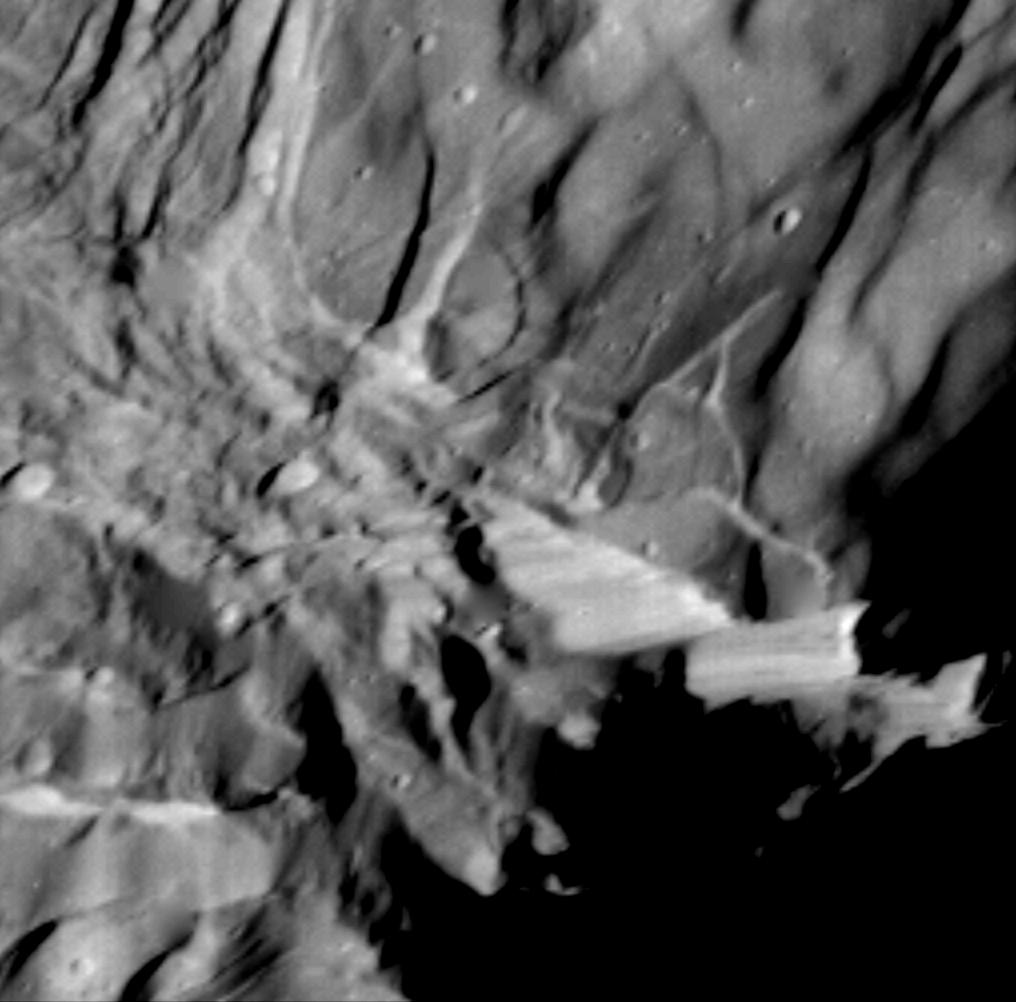
This is a picture of Verona Rupes. It is the tallest known cliff in the solar system and it is located on Miranda, Uranus' moon. It is supposed to be 20 km deep which is about 10 times the depth of the Earth's Grand Canyon. Miranda was named after Miranda in Shakespeare's play The Tempest. Miranda actually looks similar to our moon. It is gray and it has all these craters and broken terrain. However, it's surface may be mostly water ice. Despite the depth of this canyon, I was surprised to read that someone could actually jump off of this cliff and survive. Because of it's low gravity, it would take 12 minutes for a person to reach the bottom at the speed of 200 km/hr which is about the speed of a race car, but with the proper airbag protection, a person could actually survive. This picture was taken by the passing Voyager 2 robotic spacecraft in 1986. They do not know what created this cliff but they suspect it's related to a large impact or tectonic surface motion. Reading this gives me an idea of how big this cliff is and how much a difference gravity makes to be able to jump off at 200 km/hr and survive.

Thursday, March 31, 2011

APOD 4.1

2011 March 28

This APOD is not on a image but actually a video of the auroras over Norway. These auroras in the video were recorded in the north in locations like the border between Norway and Russia. The video shows a time-lapse  movie of auroras in a nature setting. There are scenes of the mountains, trees, and lakes near Kirkenes, Norway. Auroras are formed from emissions of photons in the Earth's upper atmosphere from ionized nitrogen regaining an electron and oxygen and nitrogen atoms returning from an excited state to a ground state. They are ionized or excited by the collision of solar wind particles being accelerated along the Earth's magnetic field lines. When they emit a photon of light or collide with another atom or molecule their excitation energy is lost and the return to a ground state. Oxygen emissions produce green or brownish-red auroras depending on the amount of energy absorbed. Nitrogen emissions produce blue or red auroras. The sun is predicted to be more active the next few years so there should be more auroras occurring, possibly even in locations closer to the equator. I really like this apod because I have only seen images of auroras. Seeing an aurora in action makes it even greater and more beautiful. It was also really cool to see the stars in the background and sometimes a streak of light could be seen traveling across the sky.

Tuesday, March 29, 2011

Observation (3/29/11)

Time: 6:00 AM
Location: My driveway in Osprey
Weather Conditions: Clear
This morning, I saw the moon. It was a waning crescent and it was bright. It was in the southeast. In the south Antares was visible and so was the rest of Scorpius. Next to Scorpius was Sagittarius.

Saturday, March 26, 2011

Observation (3/26/11)

Location: Service Road at Pine View
Time: 7:30 to 9:00 pm
Weather Conditions: Clear

Today was astronomy night. The skies were very clear and there were many stars visible. At first there were no stars and as the sun started to set the first magnitude stars and 2nd magnitude stars appeared and the rest followed. Sirius was the first star visible. Orion was above and his belt and dagger were visible. I could see Betelgeuse and Rigel and Canis Major next to Orion. I could make out the big dog's back, tail, and legs. Up above I could also see Castor and Pollux in the constellation Gemini and to the right of Orion was Taurus. I was able to draw out the bull's horn and in that constellation was the bright star Aldebaren. As the night went on the stars moved from east to west.

Thursday, March 24, 2011

APOD 3.9

Boston Moonrise
24 March 2011

This apod was about the full moon last week. What was special about that full moon was during its full moon phase, the moon was also at its perigee. That is the closest point in the moon's orbit to Earth. Because it was at its perigee the moon looked 14% larger and 30% brighter versus a full moon near apogee which is when the moon is farthest from Earth in its orbit. This picture was taken over Boston and you can see the atmospheric effects it has because the moon has a red and orange tint. This is similar to how it looked during the full moon last week which i was able to see. The moon was incredibly bigger and brighter. It had a little tint of yellow and orange but it wasn't as dramatic as this picture. The next time that we can see the moon this large and bright during its full phase when its at its perigee is next year on May 6. This was very cool to see and i hope to see it next year again.

Sunday, March 20, 2011

Observation (3/20/11)

Date: 3-20-11
Location: my driveway in Osprey

Yesterday at 7:40 pm I saw the moon in the east. The moon looked really large and it had a orange glow around it. The skies were clear.

When I came back out to look at it again at 10:50 pm the moon had risen higher into the air and its size appeared normal again. It also lost it's orange glow but it seemed to have a small halo around it.

Friday, March 18, 2011

APOD 3.8

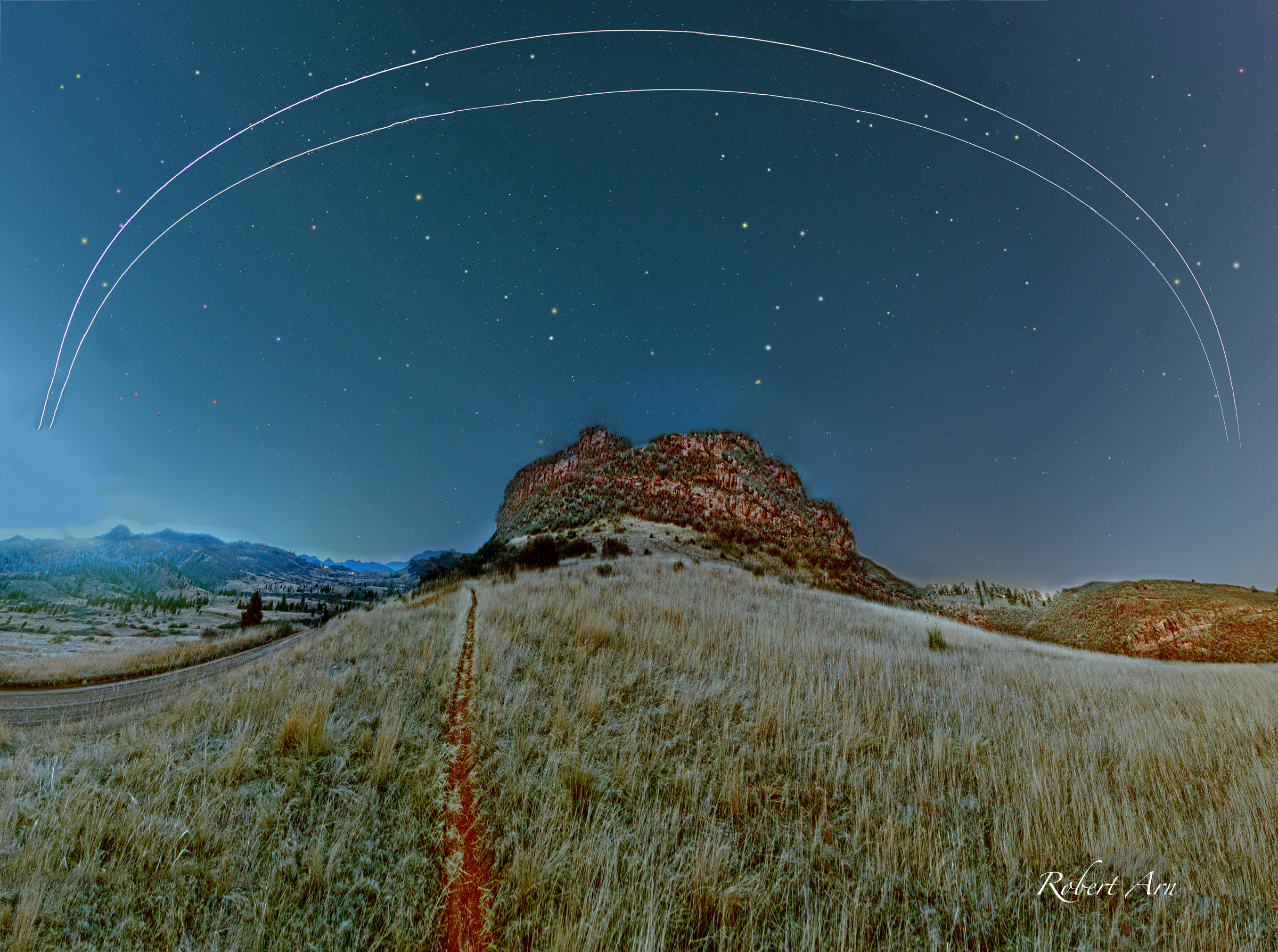
Spacecrafts Streak Over Colorado
(2011 March 14)

This picture was taken at Lory State Park, Colorado, USA. This shows the night sky with two arcs across. These two arcs are the lights of the International Space Station (ISS) and the space shuttle Discovery, which had undocked from the ISS a few hours earlier. This apod talks about drifting "stars" and what they actually are. Most likely, if someone sees a slowly drifting "star" it is probably a spacecraft in low Earth orbit that is reflecting back sunlight as it is orbiting Earth. Two of the brightest spacecrafts today are the ISS and a NASA space shuttle when it is in the sky. Iridium communication satellites are also a common cause for these bright drifting objects. Sometimes they may also reflect sunlight or they will flare up when they are re-entering Earth's atmosphere. Websites like heavens-above.com can be a great way to identify these iridium flares and other bright drifting objects that you are unsure of. It was interesting to read of other objects in the sky that you might see besides meteors. The picture also showed a great view of the path of the two objects and the best part was when you move your mouse over the picture it drew out and identified the constellations that were currently in the sky. You could see Perseus, Cassiopeia, Cepheus, Draco, Ursa Minor and Major, Camelopardalis, Leo, Leo minor, cancer and lynx. It really helps to have the constellations drawn out to help people who are still learning to see where it is in the night time sky. Even though starlab is a great way to learn the constellations in the sky, it's hard to take what you've seen there and try to find it in the real sky because it often looks different than it does in the lab.